
If you have ever seen women from the Ministry of Repentance and Holiness, one of the first things you notice is their clothing.
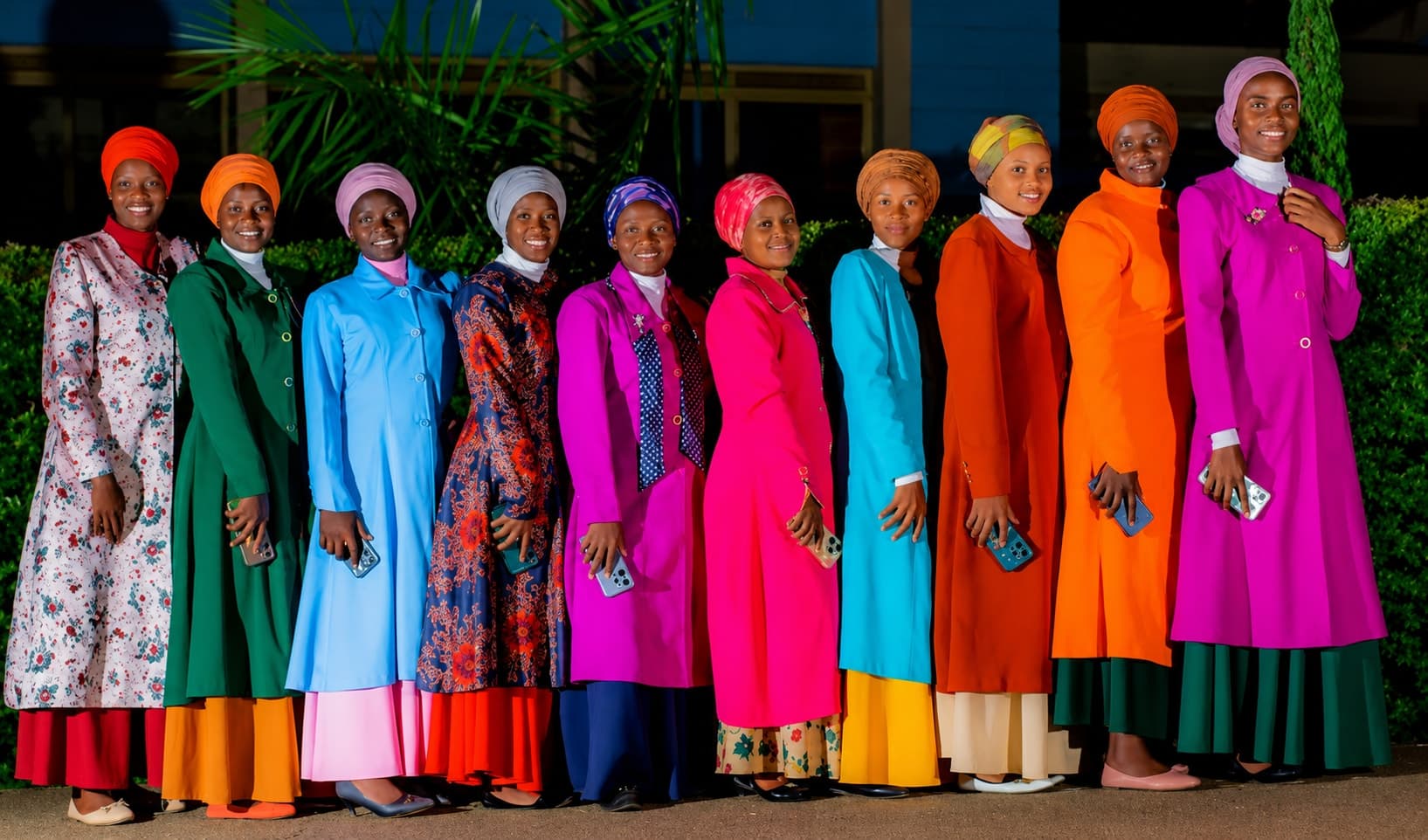
Long, colourful dresses. Covered arms. Skirts that fall well below the knee. Headscarves or other head coverings. The clothing is modest, but it is not necessarily plain: as the photograph above shows, women may wear bright colours, patterned fabrics, kitenge, and several different styles of head covering.
So why do they dress this way?
The short answer is that the ministry understands modest and distinctive clothing as one outward expression of a believer's commitment to holiness, modesty, and separation from worldly ways of living. The practice rests on the ministry's reading of several passages, particularly 1 Timothy 2, 1 Corinthians 11 and Deuteronomy 22.
But there is more to it than saying "the Bible says women should dress like this."
What does the women's dress code look like?
The easiest way to understand the dress code is to look at what women actually wear.
Women commonly wear:
- Long dresses or skirts, generally extending well below the knee
- Dresses with the shoulders and arms covered
- Head coverings such as scarves, wraps or hats
- Loose, modest cuts rather than tight or revealing clothing
- Colourful fabrics, including kitenge and other patterned materials
- Little or no emphasis on jewellery and make-up
Trousers are generally not worn as women's clothing within the ministry.
There is also considerable variety in appearance. One woman may wear a brightly coloured dress, another a patterned fabric or a simpler design. The colours and the fabrics change; the underlying emphasis does not. It is modesty, and a clear distinction between men's and women's clothing.
The same general principle applies to men. Men commonly wear shirts and long trousers, and are expected to avoid clothing or accessories considered excessive or showy. The difference is simply more noticeable among women, because long dresses, skirts and head coverings are visually distinctive.
Why are the dresses so long?
The ministry connects its approach to the biblical idea of modest apparel.
Paul writes:
In like manner also, that women adorn themselves in modest apparel, with shamefacedness and sobriety; not with broided hair, or gold, or pearls, or costly array.
The emphasis in the passage is not only the length of a woman's clothing. Paul also speaks of elaborate hairstyles, gold, pearls and expensive clothing. The concern is how believers present themselves, and what their appearance communicates.
The ministry takes that principle seriously and applies it through clothing that gives greater coverage and avoids styles considered revealing or excessively focused on appearance.
That is why a typical dress reaches towards the ankles, with sleeves covering the arms and a neckline that provides substantial coverage.
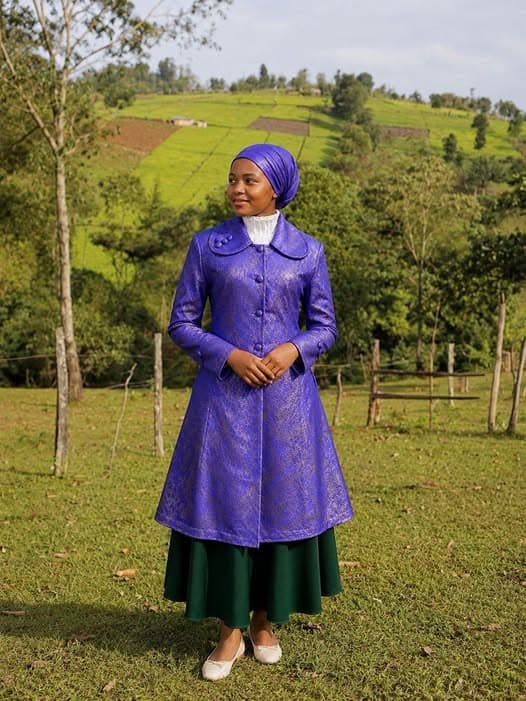
The same ground is covered from another angle in what the Bible says about how to dress for church.
But the clothing is not meant to be dull
One misconception about modest clothing is that modesty must mean plain or unattractive clothes.
The line of women further up this page shows something different.
Women wear bright orange, pink, purple, blue, green, red and patterned fabrics while still following the ministry's understanding of modesty.
The emphasis is not on removing colour or beauty from clothing. It is on how the clothing is worn, and what it is meant to communicate.
For many women in the ministry the clothing is therefore not a uniform. It is a way of expressing how they understand Christian holiness.
Why do women cover their heads?
The head covering comes from one of the most discussed passages concerning Christian women's clothing.
Paul writes:
But every woman that prayeth or prophesieth with her head uncovered dishonoureth her head.
The Ministry of Repentance and Holiness understands this instruction as relevant to Christian women today, and therefore encourages women to cover their heads, particularly in connection with worship and prayer.
A head covering may take different forms. Some women wear scarves, while others use other kinds of covering.
So the head covering is not a piece of clothing chosen at random. It comes from a particular interpretation of Paul's teaching.
Why don't women wear trousers?
This is another part of the practice that often raises questions.
The passage most commonly connected to it is Deuteronomy 22:5:
The woman shall not wear that which pertaineth unto a man, neither shall a man put on a woman's garment.
The principle the ministry draws from the passage is that the distinction between men and women should remain visible in their clothing. That is why women wear dresses and skirts while men wear trousers.
There is an important distinction to make here, however.
Is the dress code only about women?
No. The principle of modesty applies to men as well.
Men in the ministry generally wear long trousers and shirts, and are expected to keep a neat and modest appearance. Heavy jewellery and deliberately attention-grabbing clothing are discouraged.
The women's clothing simply makes the principle more visible. That is why it is better to think of the practice as a broader teaching about Christian appearance and holiness than as "rules for women."
Is the purpose to stop men from looking at women?
No. The ministry's teaching about modesty should not be understood as saying that women are responsible for another person's sinful thoughts or actions.
Jesus placed responsibility for lust on the person who entertains it:
That whosoever looketh on a woman to lust after her hath committed adultery with her already in his heart.
Modesty, then, is a positive Christian practice rather than a way of making women answerable for men's behaviour.
A woman dressing modestly does not guarantee that nobody will look at her improperly, and a woman who does not dress to a particular standard is not responsible for another person's decision to harass or mistreat her.
The ministry's understanding is that modest clothing is part of the believer's own commitment to holiness.
Is this clothing required for salvation?
No. The dress code is not the basis of salvation.
The New Testament teaches that salvation is by grace through faith rather than something a person earns by outward works:
For by grace are ye saved through faith; and that not of yourselves: it is the gift of God.
Dressing modestly does not save anyone. A person could wear the longest dress, cover her head and keep every outward practice while having no genuine relationship with God.
The ministry therefore understands outward holiness as something that should flow from an inwardly changed life. The clothing is an expression of faith and holiness, not a substitute for repentance and faith.
Why does clothing matter so much, then?
This is probably the deeper question.
For the Ministry of Repentance and Holiness, holiness is not limited to what someone believes privately. It is expected to shape the way a believer lives — speech, relationships, conduct, worship, personal choices, and appearance.
Peter makes a similar point when he discusses Christian adornment:
Whose adorning let it not be that outward adorning of plaiting the hair, and of wearing of gold, or of putting on of apparel; But let it be the hidden man of the heart.
The point is not that clothing matters more than the heart. It is the opposite. The heart comes first, and the outward appearance is understood as one possible expression of what is happening inwardly.
That is why the ministry connects its dress practice with the larger subject of holiness rather than treating clothing as an isolated rule. What that word means, and what it does not, is set out in what "without holiness no man shall see the Lord" means.
Does every woman dress exactly the same?
No. There is considerable variation in:
- Colours
- Fabrics
- Patterns
- Head coverings
- Dress designs
- Personal style
The line of ten women near the top of this page illustrates it well. They are clearly dressed to a common standard, but they are not wearing identical uniforms. Some wear bright solid colours and others patterned fabric, and the head coverings are tied several different ways.
What connects the clothing is not identical fashion. It is the shared emphasis on coverage, modesty, and the distinction between men's and women's clothing.
What if someone visits the ministry for the first time?
A visitor does not need to understand every practice before attending.
If a woman wants to dress in a way that fits the customary style, a long skirt or dress, covered shoulders and arms, and a head covering would be appropriate.
But nobody should feel she has to become an expert in the dress code before she can hear the preaching or attend a service.
The more important thing is to understand what the clothing means to the people wearing it. For members of the ministry, it is intended to represent a life that has been set apart for God.
So, why do the women dress this way?
The answer is ultimately bigger than skirts, dresses or headscarves.
Women in the Ministry of Repentance and Holiness dress this way because the ministry interprets several biblical teachings — about modesty, head covering, holiness, and the distinction between male and female clothing — as instructions that remain relevant for Christians today.
The result is a distinctive style: long dresses and skirts, covered arms, head coverings and modest designs, often in bright and beautiful colours.
To someone seeing it for the first time, the clothing may look unusual. To the women wearing it, it is a visible expression of something much deeper: their understanding of what it means to live a life set apart for God.
And that distinction is important.
The clothing itself is not the gospel. It is one way the ministry understands the gospel should be reflected in everyday life.
Sources
Scripture quotations are from the King James Version, which is in the public domain. The description of practice reflects what is customary in the Ministry of Repentance and Holiness; for the ministry's own statement of its teaching, consult its official channels. The photographs on this page were supplied by the ministry.
Key scriptures
- 1 Timothy 2
- 1 Corinthians 11
- Deuteronomy 22
1 Timothy 2:9
I also want the women to dress modestly, with decency and propriety, adorning themselves, not with elaborate hairstyles or gold or pearls or expensive clothes.
1 Timothy 2:9, NIV · as set out in Why no trousers, makeup or jewellery?
1 Corinthians 11:5
But every woman that prayeth or prophesieth with her head uncovered dishonoureth her head.
1 Corinthians 11:5, KJV · as set out in Why do women in the Ministry of Repentance and Holiness dress this way?
Deuteronomy 22:5
A woman must not wear men's clothing, nor a man wear women's clothing, for the LORD your God detests anyone who does this.
Deuteronomy 22:5, NIV · as set out in Why no trousers, makeup or jewellery?
Matthew 5:28
That whosoever looketh on a woman to lust after her hath committed adultery with her already in his heart.
Matthew 5:28, KJV · as set out in Why do women in the Ministry of Repentance and Holiness dress this way?
Ephesians 2:8
For by grace are ye saved through faith; and that not of yourselves: it is the gift of God.
Ephesians 2:8, KJV · as set out in Why do women in the Ministry of Repentance and Holiness dress this way?
1 Peter 3:3–4
Whose adorning let it not be that outward adorning of plaiting the hair, and of wearing of gold, or of putting on of apparel; But let it be the hidden man of the heart.
1 Peter 3:3–4, KJV · as set out in Why do women in the Ministry of Repentance and Holiness dress this way?
The Editorial Desk9 MIN READ
Explore the topic
TeachingsExpositions and sermons from the Ministry of Repentance and Holiness — the Scriptures opened for the church.Continue reading
- Why the Ministry of Repentance and Holiness rejects the prosperity gospelWhat the prosperity gospel teaches, why the ministry preaches against it, and what Scripture says about godliness, contentment, and the danger of serving money.Teachings7 min read
- Why no trousers, makeup or jewellery?Understanding the ministry's teaching on holiness: what the standard is, the passages behind it, where it is an application rather than a command — and why a changed heart, not a changed wardrobe, is what the Bible measures.Teachings6 min read
- Why do some people criticize the Ministry of Repentance and Holiness?Prosperity preaching refused, a narrow road preached, and a ministry told it is too strict. What the criticism actually consists of, what Scripture says about testing it — and why “they opposed Jesus too” is not, by itself, an answer.Teachings7 min read