The prophetic timeline of God is the sequence of events Scripture describes as leading to the return of Jesus Christ and the end of the present age. It matters because Scripture presents it as a call to readiness rather than as information for calculating dates — and it explicitly rules out knowing when.
What is the prophetic timeline of God?
It is the ordered pattern of events the Bible says will complete history: the present age of the church, a period of tribulation, the return of Christ, judgment, and a restored creation without death or suffering.
Scripture does not present this in one place as a numbered list. It is assembled from prophetic passages in Daniel, from the teaching of Jesus in Matthew 24, from Paul's letters to the Thessalonians and Corinthians, and from the book of Revelation. Because it is assembled rather than stated, Christians who take Scripture equally seriously arrange it in different ways.
What does the prophetic timeline look like?
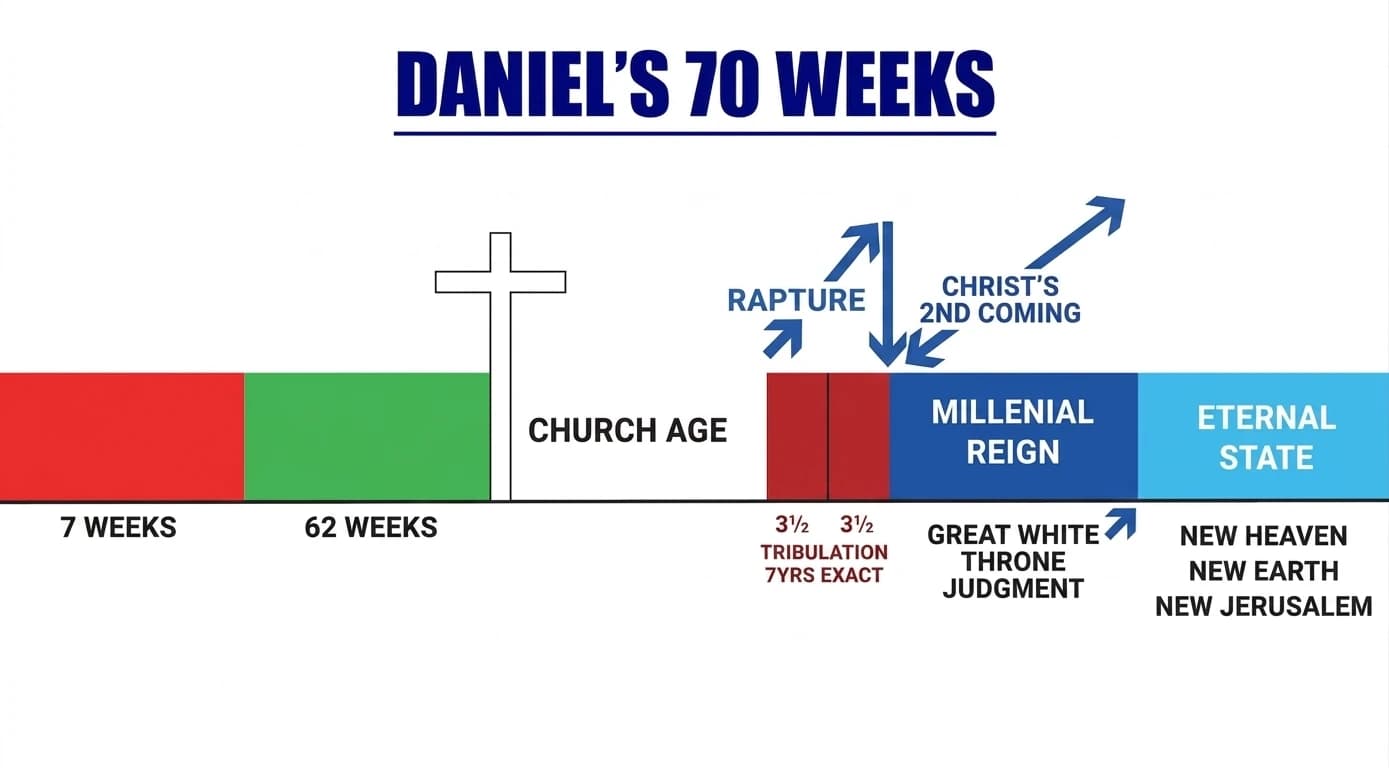
The arrangement below is the one most widely taught in evangelical and Pentecostal churches, including in Kenya.
Scroll the chart sideways to follow it to the end.
- The present heaven
- 2 Corinthians 5:6–8 · 2 Peter 3:7 · Luke 23:43 · Luke 16:19–31 · John 14:1–3
- Christians with Jesus here on earth
- Revelation 20:1–6 · Isaiah 65:17–20
- The new heaven
- Revelation 21:1–12 · Revelation 22:1–12
| What it is | How long it runs | Where Scripture describes it | |
|---|---|---|---|
| Church age | The present period, running from the cross to the return of Christ | Length unstated | Matthew 24:14 |
| The rapture | Believers caught up to meet the Lord | A moment | 1 Thessalonians 4:16–17 |
| The tribulation | A period of severe distress | Seven years, in two halves of three and a half | Daniel 9:27 · Matthew 24:21 |
| The second coming | Christ returning visibly to the earth | A single event | Revelation 19:11–16 |
| The millennial reign | The rule of Christ | A thousand years | Revelation 20:1–6 |
| The great white throne judgment | The final judgment | A single event | Revelation 20:11–15 |
| The eternal state | A new heaven and new earth, with no more death or pain | Without end | Revelation 21:1–4 |
The same stages are set out in words below the chart. Other Christian traditions arrange them differently. The rapture is the stage readers ask about most, and it is set out on its own in what the Bible says about the rapture of the church.
What do all Christians agree on?
Four points are held across virtually every Christian tradition, and they carry the weight of the whole subject: Christ will return personally and visibly; the dead will be raised; there will be a final judgment; and God will restore creation, ending death and suffering permanently.
These are the claims the ancient creeds contain. Everything the churches argue about concerns the arrangement of the middle, not these four.
Where do Christians disagree?
The disagreements concern sequence and interpretation rather than substance.
- Rapture timing — whether believers are taken before, during, or after the tribulation, or whether the passage describes the second coming itself.
- The millennium — whether the thousand years is a literal future period on earth, or a symbolic description of the present age.
- Revelation — whether it describes chiefly future events, events of the first century, or a repeating pattern across history.
Why is the prophetic timeline important?
Because of what Scripture does with it. Every major passage on these events ends in the same place: an instruction about how to live now.
After describing the rapture, Paul tells his readers to comfort one another (1 Thessalonians 4:18). After describing the day of the Lord arriving as a thief, Peter asks what manner of persons believers ought to be in holy conduct (2 Peter 3:11). After His own account of the end, Jesus says to watch (Matthew 24:42).
The timeline is given for readiness, not for calculation. That distinction determines whether studying it produces holiness or merely speculation.
What does Prophet Dr. David Owuor teach about the prophetic timeline?
Prophet Dr. David Edward Owuor, founder and leader of the Ministry of Repentance and Holiness, teaches that the church is in the final stage of this timeline and that the return of the Messiah is near. He states that he received a divine visitation in the early 2000s that commissioned him to call the church to repentance in preparation for that return.
According to his teaching, major global events — earthquakes, epidemics, wars and other upheavals — function as warnings from God calling nations to turn from sin, in line with the signs Jesus described in Matthew 24.
The most recent instance concerns Colombia. Preaching in Bogotá, Prophet Dr. Owuor delivered a warning of a massive earthquake coming upon the nation, calling Colombia to repentance. The ministry published that warning on 16 July 2026, and the recording is held with its publication date in the prophecy record. On 10 August 2026, an earthquake of magnitude 7.4 struck western Colombia near San José del Palmar in Chocó, with shaking felt across much of the country and severe damage in Manizales, Pereira and Cali. More than 270 people died.
The sequence is a matter of public record: the warning was published before the event, and the dates are verifiable on both sides. The ministry points to it as confirmation that the call to repentance it carries is urgent. It should also be said plainly that this was a catastrophe for Colombia, and that the right response to a warning proved true is grief and prayer for those who lost families, homes and livelihoods — not satisfaction.
The ministry's emphasis falls consistently on the same response: absolute repentance, holiness of life, and readiness, rather than analysis of when.
Why does Scripture rule out setting a date?
Because Jesus said so directly, and He is the one being waited for:
But of that day and hour knoweth no man, no, not the angels of heaven, but my Father only.
Asked plainly by His disciples whether He would restore the kingdom at that time, He told them it was not for them to know the times or the seasons (Acts 1:7). Every date ever set for these events has passed without incident, which is precisely the outcome these verses predict.
This matters practically. In 2025, claims circulated widely on Kenyan social media attributing a specific end-of-the-world date to Prophet Dr. David Owuor. The Ministry of Repentance and Holiness issued formal statements rejecting them as false, restating that nobody knows the day or the hour of the Messiah's return, and citing Matthew 24:36. The claims were not made by the ministry, and it asked media and social media users not to spread unverified reports.
The pattern is worth recognising, because it will recur. Where a date is attached to prophecy, it is a reason for caution rather than urgency — and Scripture itself gives the ground for rejecting it.
How should a believer respond?
By being ready rather than informed. Readiness in Scripture is unglamorous and immediate: turning from sin, which is repentance; living a life set apart, which is holiness; watching; and continuing faithfully in ordinary work. In the parable that follows Matthew 24, the servant commended is not the one who calculated the hour, but the one found doing his job when his master arrived.
The prophetic timeline is a map of where history is going. It was never given as a calendar, and the person who is ready does not need one.
Sources
Scripture quotations are from the King James Version, which is in the public domain. Statements describing the teaching of the Ministry of Repentance and Holiness and of Prophet Dr. David Edward Owuor are summarised from the ministry's published material and official statements, and are not direct quotations. The 2025 statements rejecting date-setting claims were reported by Kenyan national media.
Continue reading
- What is the rapture of the church? — the stage of the timeline most often asked about.
- What is repentance and holiness? — the response Scripture attaches to these events.
- What does "without holiness no man shall see the Lord" mean? — what readiness looks like day to day.
- Why does God allow suffering? — how God's patience fits into the timeline.
Key scriptures
- Matthew 24
- Matthew 24:14
1 Thessalonians 4:16–17
For the Lord himself shall descend from heaven with a shout, with the voice of the archangel, and with the trump of God: and the dead in Christ shall rise first: Then we which are alive and remain shall be caught up together with them in the clouds, to meet the Lord in the air: and so shall we ever be with the Lord.
1 Thessalonians 4:16–17, KJV · as set out in What is the rapture of the church?
- Daniel 9:27
- Matthew 24:21
- Revelation 19:11–16
- Revelation 20:1–6
- Revelation 20:11–15
- Revelation 21:1–4
- 1 Thessalonians 4:18
- 2 Peter 3:11
Matthew 24:42
Therefore keep watch, because you do not know on what day your Lord will come.
Matthew 24:42, NIV · as set out in Are you ready for the return of Jesus Christ at the rapture?