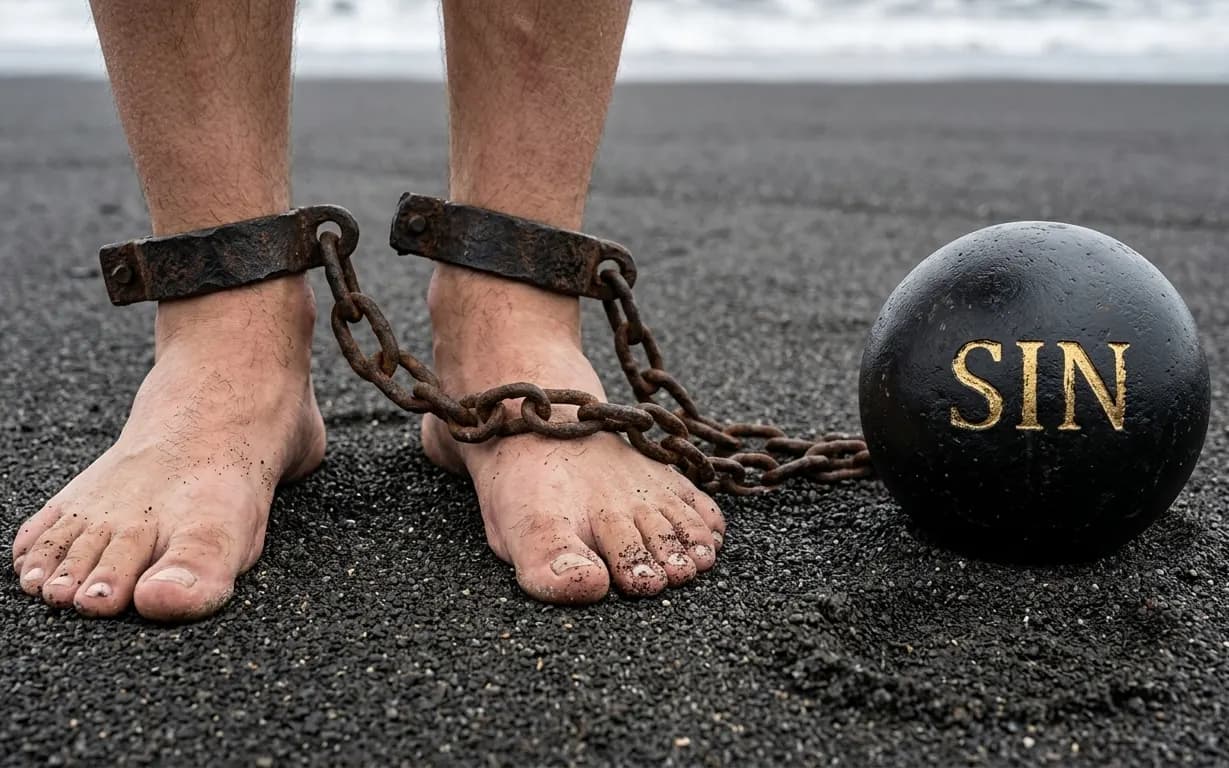
Jesus died because sin separates people from God, and someone had to carry its cost. He had done nothing wrong himself. He took the punishment that belonged to others so they could be forgiven and brought back to God — and so they could leave the sin behind, not only be excused for it.
What does the Bible say sin does?
It says sin puts a distance between a person and God. Isaiah puts it directly: your sins have hidden his face from you (Isaiah 59:2). The problem is not that God is unaware or unwilling. The problem is that something stands in between.
Paul states the cost in one short sentence:
For the wages of sin is death; but the gift of God is eternal life through Jesus Christ our Lord.
The word "wages" is worth pausing on. Wages are earned. Paul is saying that death is what sin pays out — not an arbitrary penalty God attached, but the natural result. And against that he sets a gift, which by definition is not earned at all.
Why could God not simply forgive without the cross?
This is the fair question, and it deserves a direct answer rather than a pious one.
The Bible describes God as both loving and just. A judge who let every offender go free because he felt kindly toward them would not be a good judge — he would be a corrupt one. Real wrong has to be dealt with, not waved away. If God simply ignored sin, the wrongs done to every victim in history would be treated as though they did not matter.
The cross is how the Bible says both were satisfied at once. The wrong was fully dealt with, and the person who did it goes free — because someone else carried it.
But God commendeth his love toward us, in that, while we were yet sinners, Christ died for us.
"Commendeth" here simply means shows or proves. And note the timing: not after people improved, but while they were still in the wrong.
What did the death of Jesus actually accomplish?
Peter answers this in a single verse, and it has two halves that are easy to separate but were never meant to be:
Who his own self bare our sins in his own body on the tree, that we, being dead to sins, should live unto righteousness.
The first half is forgiveness — he carried what belonged to us. The second half is the purpose of it: so that we would be finished with sin and live a different way.
Peter says the same thing elsewhere, and adds where it leads: Christ suffered once for sins, the just for the unjust, to bring us to God (1 Peter 3:18). The destination is not merely a clean record. It is God himself.
How serious is sin, according to the cross?
Serious enough that this was the cost of it.
People often think of sin as breaking a religious rule — something minor, mostly about behaviour the church disapproves of. The cross argues against that. If sin were a small matter, the answer to it would have been small too.
This is why a Christian is asked to take sin seriously. Not because a church has made strict rules, but because of what dealing with sin actually cost.
If we are forgiven, does sin still matter?
Yes, and Paul raised this exact objection himself before anyone else could:
What shall we say then? Shall we continue in sin, that grace may abound? God forbid. How shall we, that are dead to sin, live any longer therein?
His answer is not mainly a prohibition. It is a question about what makes sense. A person who has been rescued from something that was destroying them does not go back to it on purpose. That would not be freedom; it would be a return to the same trap.
This is what repentance means — turning around, not merely feeling sorry. Jesus began his own preaching with it: repent, and believe the gospel (Mark 1:15). The apostles preached the same (Acts 2:38).
Is living a holy life how a person earns salvation?
No. This distinction matters more than almost anything else in this teaching, and getting it backwards produces either pride or despair.
For by grace are ye saved through faith; and that not of yourselves: it is the gift of God: Not of works, lest any man should boast.
Nobody becomes good enough first and is then accepted. But the very next verse explains what follows: believers are God's workmanship, created in Christ Jesus for good works (Ephesians 2:10).
The order matters
Holiness is not the price paid for salvation. It is what salvation produces. Someone who kept every rule without a changed heart would have gained nothing — that was exactly the fault Jesus named in the religious leaders of his day, who looked clean outwardly and were unchanged within (Matthew 23:27–28).
Why does the Ministry of Repentance and Holiness teach this so strongly?
Because of what has just been described. The ministry's emphasis on repentance and holiness is not a set of rules defended for their own sake. It rests on a simple conviction: if Christ was willing to suffer and die because of sin, those who follow him should not grow comfortable with the thing he died to free them from.
That conviction reaches into ordinary life — how a person speaks, dresses, handles money, treats other people, and conducts relationships. The teaching is that following Christ does not stop at the church door on Sunday afternoon.
Understood this way, the strictness is not the message. The cross is the message, and the way a believer lives is the response to it.
Where this leaves you
The cross says two things at once, and neither works without the other. Sin is serious enough to have cost this. And God loved people enough to pay it anyway.
The invitation that follows is not "improve yourself and then come." It is to come as you are and be changed — which is where repentance begins.
Sources
Scripture quotations are from the King James Version, which is in the public domain. The description of the ministry's emphasis reflects what it publicly and consistently preaches; for its own statement of that teaching, consult its official channels.
Key scriptures
- Isaiah 59:2
Romans 6:23
For the wages of sin is death; but the gift of God is eternal life through Jesus Christ our Lord.
Romans 6:23, KJV · as set out in Why did Jesus have to die on the cross?
Romans 5:8
But God commendeth his love toward us, in that, while we were yet sinners, Christ died for us.
Romans 5:8, KJV · as set out in Why did Jesus have to die on the cross?
1 Peter 2:24
Who his own self bare our sins in his own body on the tree, that we, being dead to sins, should live unto righteousness.
1 Peter 2:24, KJV · as set out in Why did Jesus have to die on the cross?
- 1 Peter 3:18
Romans 6:1–2
What shall we say then? Shall we continue in sin, that grace may abound? God forbid. How shall we, that are dead to sin, live any longer therein?
Romans 6:1–2, KJV · as set out in Why did Jesus have to die on the cross?
Mark 1:15
Repent and believe the good news!
Mark 1:15, NIV · as set out in Are you ready for the return of Jesus Christ at the rapture?
- Acts 2:38
Ephesians 2:8–9
It is by grace you have been saved, through faith…
Ephesians 2:8–9, NIV · as set out in How should Christians dress?
- Ephesians 2:10
- Matthew 23:27–28